If you want to know where the smart money is going in 2025, look no further than Apple’s jaw-dropping $600 billion investment in America. That’s not a typo. $600 billion. The largest investment Apple has ever made—anywhere—will be planted right here on American soil. It’s not just a win for Apple or for President Trump’s economic agenda—it’s a seismic shift that every investor, job creator, and market-watcher needs to pay attention to.
Let’s cut through the noise: this isn’t just about Apple building some new offices or slapping a few “Made in USA” stickers on their products. This is about reshaping the industrial and technological landscape of the United States. It’s about revitalizing domestic manufacturing, supercharging the AI and semiconductor sectors, and creating a ripple effect that will touch every corner of the American economy.
First, the job numbers. Apple’s American Manufacturing Program is projected to create over 20,000 direct jobs—and that’s just the beginning. Those numbers multiply rapidly when you factor in the suppliers Apple is partnering with: Corning, Broadcom, Texas Instruments, and even Samsung. This is trickle-down economics in the best possible way—private sector-led, market-driven, and rooted in real production, not government handouts.
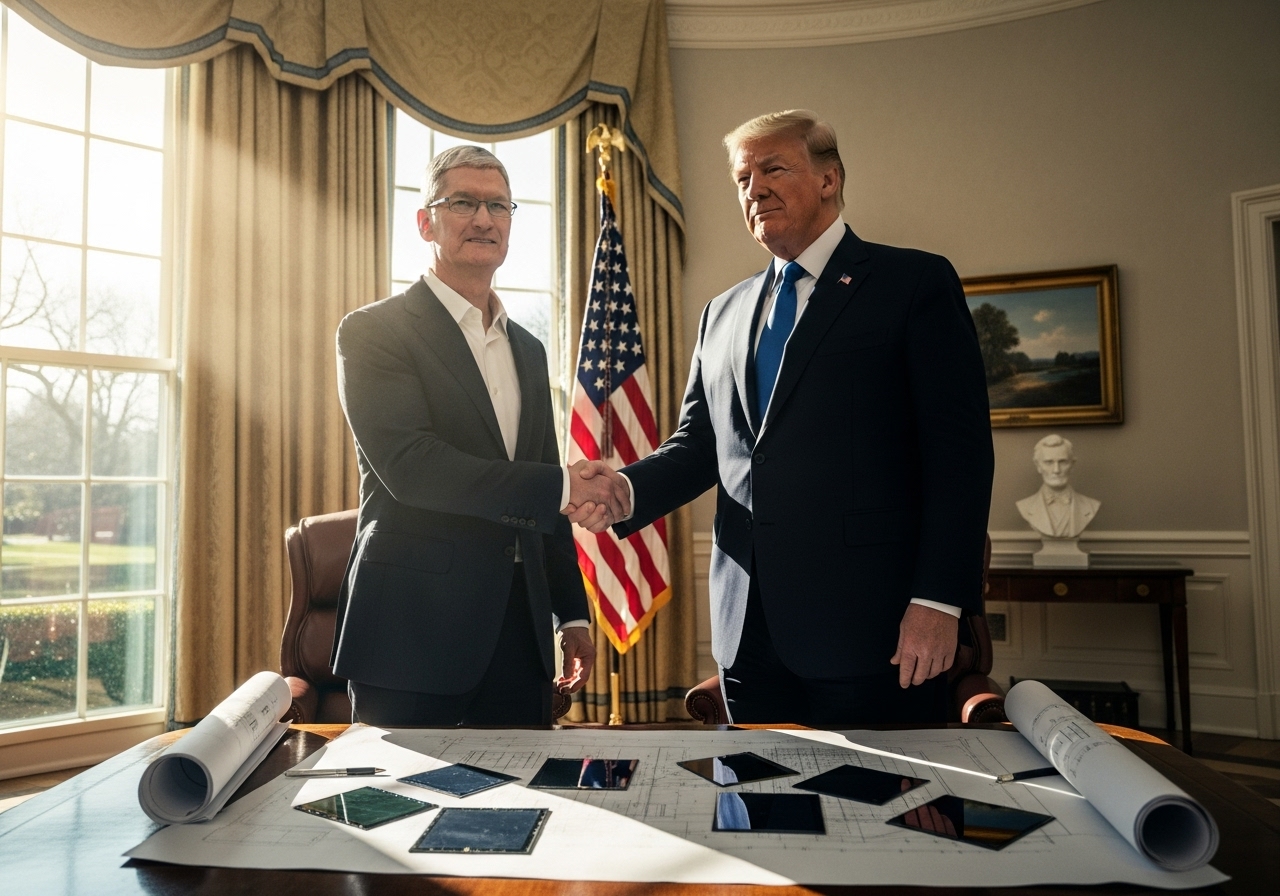
There’s a reason Apple’s CEO Tim Cook stood beside President Trump in the Oval Office to make this announcement. The regulatory and tax climate under this administration has made it attractive—finally—for major corporations to bring capital and production back to the United States. “We’re committing an additional $100 billion to the United States,” Cook said, “bringing our total US investment to $600 billion.” That’s not a PR stunt. That’s a serious, long-term bet on America’s future.
Investors should be paying close attention to where this money is going. Kentucky will become home to the world’s largest smart glass production line. Houston is getting a massive 250,000 square-foot facility for server manufacturing. Data centers are going up in North Carolina, Iowa, and Oregon. And Apple’s not stopping there—they’re launching a manufacturing academy in Detroit, a rare earth magnet plant in Texas, a recycling line in California, and semiconductor manufacturing initiatives in Arizona, New York, Texas, and Utah.
This isn’t just economic stimulus—it’s industrial strategy. And it’s happening without the central planning and boondoggles we’ve come to expect from left-wing economic schemes. No Solyndra-style taxpayer bailouts here. This is the private sector, unleashed.
Let’s talk about the strategic implications. Apple’s decision to invest more heavily in U.S.-based semiconductor production in particular is a direct response to the global chip war and the growing recognition that America must no longer rely on China or Taiwan for critical technology inputs. This is national security meets economic security—a rare but essential combination. The Mountain Pass, California, investment in rare earth recycling is a similar play. For too long, we’ve ceded control of these vital resources to adversarial powers. That era is ending.
And don’t overlook the AI angle. Apple is expanding its data center capacity significantly, planting billions into infrastructure that will power the next generation of artificial intelligence. That’s not just about Siri getting smarter. It’s about laying the groundwork for advances in medicine, automation, cybersecurity, and more. This is how America wins the AI race—by building the backbone of innovation right here at home.
To the average investor, these developments offer a roadmap. Real assets, real output, real American jobs. The companies linked to this growth—from Apple’s suppliers to regional construction firms to semiconductor equipment manufacturers—are going to benefit from a capital surge unlike anything we’ve seen in a generation.
It’s a reminder that America’s economic engine thrives when the government gets out of the way and lets the innovators lead. With President Trump back in the Oval Office, the message is clear: America is open for business, and the world’s biggest companies are taking notice.
So if you’re looking for where the future is being built, don’t look offshore. Look to Houston, Harrodsburg, Detroit, and beyond—because the American economy isn’t just recovering. It’s roaring back to life, one billion-dollar investment at a time.